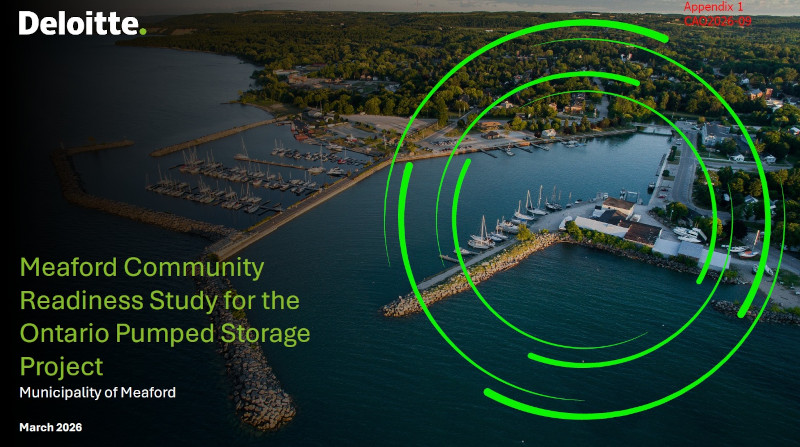
A 48-page report was presented to council during a special meeting held on the morning of Monday, April 27. Included in the report was a study undertaken by consulting company Deloitte entitled Meaford Community Readiness Study for the Ontario Pumped Storage Project.
“Deloitte was retained by the Municipality to develop the Meaford Community Readiness Study for the Ontario Pumped Storage Project. The study is intended to provide insight into the potential impacts and opportunities that currently exist, or may arise, through the construction and operation of the proposed Ontario Pumped Storage Facility,” staff told council in their introduction to the study.
The study explores the potential economic impacts of the proposed pumped storage facility, along with the expected social and infrastructure impacts. Deloitte’s report explores many areas including housing, education, healthcare services, and recreation, as well as police and fire services.


“The focus of this study is on Meaford and the surrounding region (including the Census Divisions of Grey County, Bruce County, and Simcoe County), referred to as “the local region”. The analysis draws on economic modelling, secondary data, and extensive qualitative input from local and regional stakeholders across municipal services, social infrastructure, and workforce development,” Deloitte noted in their report.
The report notes that the pumped storage project, should it be permitted to proceed, will generate significant economic benefit for the community, while highlighting that Meaford’s social and infrastructure systems are not designed to absorb the rapid population increase that would come with the project during the years of construction.
“The investments in the Project are estimated to generate significant economic benefits for the community of Meaford. Capital expenditures between 2028 and 2035 are estimated to contribute $5.5 billion to GDP and sustain about 15,600 job-years of employment over the construction period. Additionally, operations are expected to contribute $118 million to GDP and sustain approximately 600 jobs in the local region, annually, on average, during the project’s 80-year lifespan,” Deloitte said in their report. “Meaford’s social and infrastructure systems were not designed to absorb a rapid, concentrated population increase. The arrival of 800-900 temporary construction workers is expected to create short-term pressure on local services, particularly housing, elementary education, and wastewater. Over the longer term, the project may contribute to gradual population growth and structural changes affecting municipal planning.”
Housing was one of the areas of focus for the study, which suggests that the temporary influx of 800 to 900 workers (earlier predictions had been as high as 1,800 workers) will increase pressure on Meaford’s housing market.
“In the short term, the construction phase of the proposed Pumped Storage Project is expected to generate significant but largely temporary pressures across housing, infrastructure, and community services. An influx of approximately 800-900 construction workers over a two- to three-year period will intensify demand for housing and accommodations that the local market cannot readily absorb, reinforcing regional commuting patterns and increasing reliance on short-term and seasonal lodging. This population increase will place additional strain on other areas such as healthcare, policing, and fire response, particularly during daytime hours and peak construction activity, when capacity is already constrained in most of these services,” noted the report.
Meaford’s road system is also a concern as noted in the report.
“Transportation networks will experience heightened congestion and safety risks due to increased heavy-truck movements on rural, county and provincial roads, accelerating pavement wear and creating administrative burdens for staff responsible for traffic management and permitting. Schools operating above capacity may face enrolment pressures requiring additional portables and staffing, while most recreational and cultural facilities can absorb short-term increases in use with minor operational adjustments. Economically, the project is expected to provide a short-term boost to local businesses, though higher project wages may temporarily tighten the local labour market,” the report informed.
While there would be many short-term impacts if the project is allowed to proceed, the report also identified long-term concerns for council to consider.
“Over the long term, sustained population growth associated with the project would place increasing pressure on municipal services, with wastewater capacity emerging as the most significant constraint. While the water treatment system has available capacity to support future growth, the wastewater system is already operating near practical limits, and any expansion would require multi-year planning and construction timelines. This constraint limits the municipality’s ability to accommodate long-term residential or industrial development without major capital investment. Recreation and public space demands would also rise if population growth becomes permanent, particularly for waterfront amenities and facilities that already experience seasonal capacity pressures,” the report noted. “Population growth associated with the project could also place incremental pressure on housing, emergency services, education, and healthcare systems, many of which are delivered by external service providers rather than the Municipality of Meaford. Housing outcomes will depend on whether temporary construction-related demand translates into permanent relocation; however, ongoing constraints (including limited rental availability, slow housing development, and affordability challenges) are likely to continue affecting population retention and workforce recruitment. Proportional increases in demand for fire, police, and emergency response services may challenge existing volunteer-based service models and could necessitate long-term adjustments to staffing, training, or facilities, depending on future service responsibilities.”
Deputy Mayor Shirley Keaveney noted that the report was “deeply concerning”, but it was information that council needed to hear.
“In 20 minutes more or less you’ve just outlined, of course at a high level, significantly how this project will change the face of Meaford in the next few years, should construction go forward, and of course we don’t know that at this point,” Keaveney told council. “Life as we know it will not be the same.”
Keaveney noted that while economic benefits would be welcomed, those benefits need to be weighed against the many other potential impacts on the community.
“Certainly funds coming into our tax base would be wonderful, we could do great things with that, but how do we as Meaford, a small community of 12,000 people, in the short time that we have ahead of us, how do we prepare for this?” Keaveney asked.
Preparing to make the municipality ready should the project move forward will be a challenge for this and the next term of council.
“It’s the big question, the big elephant in the room, how are we going to do this?” Keaveney asked.
Mayor Ross Kentner agreed that council will need to develop plans in the coming years.
“What we have to do is make these next three or four years really count in terms of good planning and hard work,” noted Mayor Kentner.
The full report can be found on the municipal website (meaford.ca).