Submitted By Cameron Halfpenny, Chair, Leadhills Reading Society, Leadhills Miners’ Library, Scotland
An air force pilot from Meaford, whose fighter plane crashed in Scotland during WW2, was honoured in the town this week. A propeller blade rescued from Sgt George Stevenson’s Hawker Hurricane was gifted by Leadhills Miners’ Library in Scotland to his family in Ontario, to join a war memorial in the Meaford church he left to go to war in Europe.
Sgt Stevenson – known as Geordie – joined the RCAF in 1940. It was during a training flight in his native Scotland in July 1941 that he crashed near the village of Leadhills in poor weather and died aged 26. One of the plane’s three propeller blades was salvaged from the crash site, and since then has been looked after by a local hotel, then the Earl of Hopetoun, and finally the oldest subscription library in Britain, the 18th century Leadhills Miners’ Library.


Now the propeller blade’s story begins a new chapter, as this week it has been gifted by the Miners’ Library committee to Christ Church Anglican on Boucher Street East, where Sgt Stevenson was the first congregation member and local person to die in WW2.
The arrival of the artifact is the latest instalment of Meaford’s Scottish connections. These include John Muir from Dunbar near Edinburgh, the founder of the USA’s National Park system, who moved to Meaford from Wisconsin in the 1860s to avoid conscription into the American Civil War. Today it is the Canadian Army which has a local military presence with the Army Training Centre, established in the year following Geordie’s death, then known as Camp Meaford or The Tank Range.
It was another RCAF veteran, Sgt Stevenson’s nephew Andy Smart, who made the request last year to Leadhills Miners’ Library to bring the propeller blade to Meaford. He describes the object’s symbolic meaning for local people and his own family: “Viewing my uncle Geordie’s actual prop blade shines the light for all of us to honour and never forget all our fallen heroes.”
George Stevenson was born in Ayrshire in 1914 before his family emigrated to Ontario in 1928. He was Assistant Butter Maker at Meaford Creamery before joining the RCAF in 1940, becoming one of more than seven hundred wartime pilots from Canada who flew with the RAF. Three weeks after arriving in England in 1941 he left his base at RAF Crosby-on-Eden east of Carlisle and flew north to Scotland’s Southern Uplands. This featureless moorland landscape is difficult to navigate even in perfect weather, but in low cloud and mist it can be treacherous. This was how Stevenson encountered it that evening, and he crashed into the slopes of Lowther Hill just below its 2380 ft. summit.
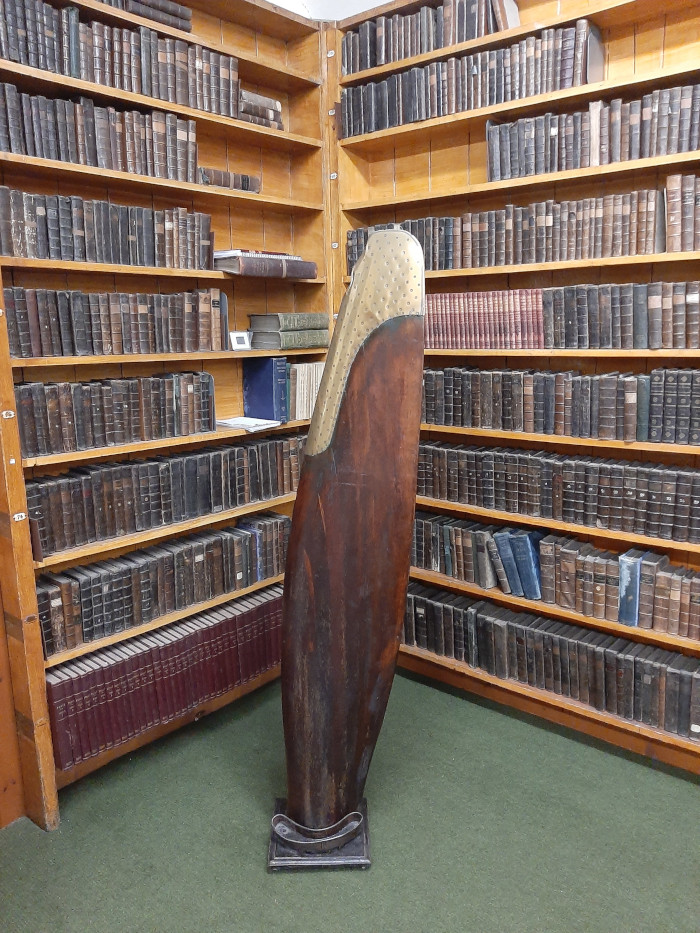
The 5 foot tall propeller blade is to be displayed alongside Christ Church Anglican’s existing artifacts, notably its WW2 Memorial Windows. These were created from fragments of stained glass recovered from English and European churches bombed during WW2. They accompany the English scorched church pew bearing fallen WW2 congregation members’ names, and a wartime letter to Sgt Stevenson’s sister from Meaford’s mayor honouring his sacrifice for Canada.
Christ Church Anglican’s minister, the Rev. Brendon Bedford, offers this view of the propeller blade’s presence in the church’s memorial: “This is a homecoming, of sorts, for Sgt George Stevenson. While he is buried in Cumberland, England, George’s church in Meaford is so pleased to be able to welcome him home, in a way, by hosting this propeller blade as a tangible memorial to his life and service. Christ Church is honoured to include this propeller blade as part of our WWII Memorial, which was dedicated 80 years ago this August in remembrance of the ultimate sacrifice made by George and five other members of our church.”
In the decades after Sgt Stevenson’s crash, the propeller blade remained in Leadhills at Scotland’s highest residential hotel, The Hopetoun Arms, where guests used it as an umbrella stand. The local land owner, the Earl of Hopetoun, then adopted it, ultimately gifting the blade to Leadhills Miners’ Library, where it has been on public display for more than 25 years. The library’s catalogue entry describes it as: “Umbrella stand made from ½ propeller blade”. During the process of transferring the blade to Canada, one of the library’s trustees – an RAF veteran – suggested that, “umbrella stand” or not, the blade was likely to still be the property of the RAF, not the library. So the approval of the Battle of Britain Trust was sought and received, and the blade’s epic story was able to carry on.
Just as Father Bedford’s words reflect losses suffered and new beginnings made, Scotland’s present Earl of Hopetoun, Andrew Hope – also a Miners’ Library trustee – feels similarly honoured to have helped the blade’s journey to continue.
“I’m delighted that the Hurricane propeller blade will become a memorial to Sgt Stevenson in his hometown, at his nephew’s request. My family gifted it to the library over 25 years ago and it is more than fitting it should continue its journey to Canada, where it will allow the family and friends of a brave young man to remember him.”
George Stevenson’s tragedy on Scotland’s unforgiving hills 85 years ago was a lonesome shock that struck in an instant. However, remembering the event over many decades – on both sides of the Atlantic – has woven many more people into Geordie’s story today. From the ties they have made over looking after a single piece of wreckage from a plane crash that happened nearly a century ago, there has emerged a collective spirit of cooperation that eclipses the personal tragedy of long ago. In these uncertain times when every nation is asking who its friends are, this symbol of sacrifice and the community gestures of compassion and respect it invokes displays unity and comradeship between our two countries.
For more photos, pick up this week’s (May 21, 2026) print edition of the Meaford Independent.