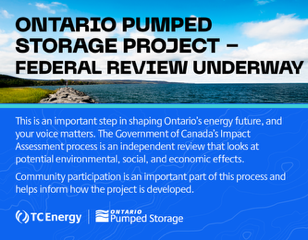
 Much has transpired over the past few weeks with regard to the Impact Assessment Agency of Canada’s (IAAC) review of TC Energy’s hydro-electric pumped storage proposal.
As most expected would happen, IAAC announced on its website last week that they have determined that TC Energy’s proposal will move on to a full impact assessment.
After the public commenting period, which ran from March 6 to April 6, in mid-May IAAC published its summary of issues regarding the proposal, noting that the proponent’s response to the summary of issues would help to determine if the full impact assessment would be required.


TC Energy provided their response to IAAC’s summary of issues in a four-page letter dated May 14. That letter can be found on IAAC’s website, and I will provide links at the end of this column for those interested in exploring further.
“It is understood that TC Energy’s response to the Summary of Issues plays an important role in determining whether an Impact Assessment is required under Section 16 of the Impact Assessment Act (IAA) and in informing the scope of the Impact Assessment and Tailored Impact Statement Guidelines (TISG),” TC Energy wrote in their response letter. “It is also understood that the response to the Summary of Issues will be used to focus the Impact Assessment and information requirements of TC Energy’s Impact Statement on the key issues raised by Indigenous rights-holders and groups, federal authorities, provincial agencies, and the public as they pertain to matters within federal jurisdiction, consistent with messaging received from IAAC as part of the recent efforts to improve efficiency of the IAA process. TC Energy trusts that the information provided will inform the Project-specific TISG in a manner that focuses the Impact Statement on such key issues.”
On Friday, May 29, IAAC posted a ‘Notice Of Impact Assessment Decision With Reasons’ on their website informing that a full impact assessment would indeed be undertaken.
“IAAC is satisfied that the carrying out of the designated project may cause adverse effects within federal jurisdiction or direct or incidental adverse effects, including potential effects on fish and fish habitat, migratory birds, changes to the environment on federal lands, effects due to activities on federal lands, and changes to the health, social, economic and environmental conditions of Indigenous Peoples,” IAAC noted in their notice published on May 29. “As a result, IAAC has determined that the designated project will move to the next step in the planning phase. The next step is the development of the Tailored Impact Statement Guidelines and plans for the project, which IAAC will issue to the proponent as part of the Notice of Commencement.”
I think the decision is good for everyone, from residents of this municipality, to the province at large, to TC Energy themselves, as with any major, or perhaps more appropriately, mega project such as this I believe that there should be as much research, study, and investigation as possible. I don’t believe that with any mega project, whatever it might be, you can afford to take any shortcuts, and the more exploration into the details beforehand, the better. Measure twice, cut once my grandfather used to say.
Local advocacy group Save Georgian Bay was quick to issue a response to IAAC’s announcement with a media release that I received on Monday, June 1, as I was preparing my notes to write this column, and as the barges that we saw out on the bay last summer were about to return to conduct further testing.
“During the IAAC public comment period, First Nations, residents, and government agencies raised substantive concerns, including written submissions from Hiawatha First Nation and Curve Lake First Nation citing inadequate consultation. The Impact Assessment Agency of Canada has now formally determined that the project may cause adverse effects—effectively confirming that these risks are real and credible. The next critical question—yet to be answered—is whether those risks are likely to occur, a determination that falls to the Minister of National Defence under Section 82 of the Impact Assessment Act,” said Save Georgian Bay in their media release.
Save Georgian Bay also expressed concern that TC Energy is once again undertaking off-shore geotechnical studies using a barge as they did last summer.
“We are calling on the federal government to immediately halt TC Energy’s drilling program until the Impact Assessment is complete and the Minister of National Defence has made a Section 82 determination. Federal agencies have already identified credible risks to drinking water and aquatic ecosystems. Allowing in-water work to proceed before those risks are fully assessed is not just premature—it reflects a troubling disregard for public safety, environmental protection, and the federal review process,” said Tom Buck, director of Save Georgian Bay.
I believe that a full impact assessment is a benefit for TC Energy as well, because if the project can hold up under the intense scrutiny of a full impact assessment, and if TC Energy can successfully address the summary published last month by IAAC through that assessment process, they might find less resistance to their project down the road should the project be permitted to move forward.
We are still a long way, likely a few years, before we will know if this proposal receives the green light to become a full-blown project, or whether it will be rejected. This proposal, whether you support it or oppose it, would change the face of this community forever, and so it should be subject to as much scrutiny as possible before a decision is made to allow it to move forward, or if it is to be rejected.
So, with IAAC determining that a full impact assessment is required for this proposal, the long and winding road continues. This proposal will continue to be one of the major issues on the minds of residents of this community, as it has been for the past six years.
To read TC Energy’s response to IAAC’s summary of issues visit:
https://iaac-aeic.gc.ca/050/evaluations/document/166628?culture=en-CA
You can read the full IAAC notice of impact decision on their website by visiting:
https://iaac-aeic.gc.ca/050/evaluations/document/166629
For all IAAC updates to the pumped storage proposal file, including links to all public comments submitted and other files, visit:
https://iaac-aeic.gc.ca/050/evaluations/proj/89803?culture=en-CA