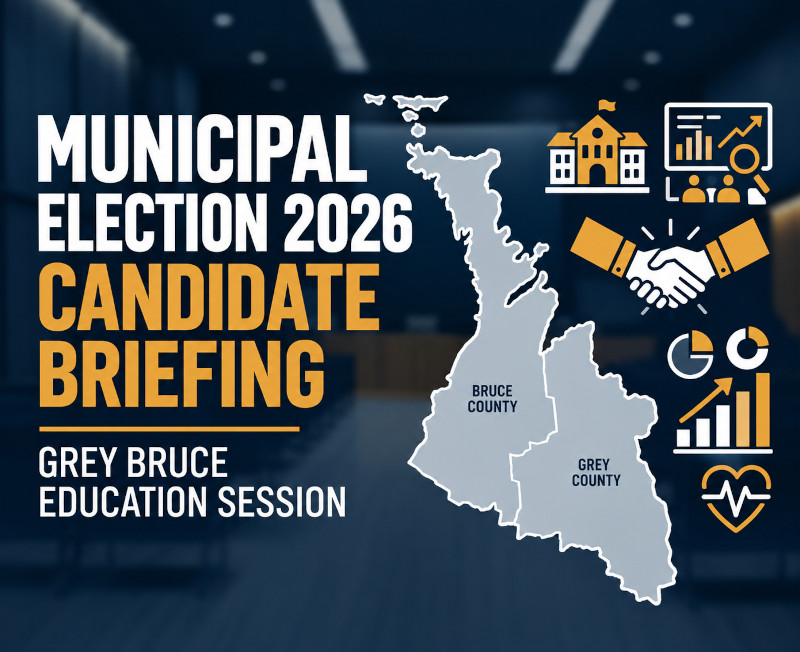
Municipal candidates from across Grey and Bruce came together online September 18 for an education session exploring poverty, housing, health, transportation, community safety, and the role municipal governments can play in addressing complex community issues.
Hosted by United Way of Bruce Grey through the Bruce Grey Poverty Task Force, the non-partisan session brought 65 people together on Zoom, including three presenters and three hosts.
The session was designed to help candidates better understand what services already exist, where gaps remain, which level of government has responsibility for different issues, and where municipalities can act directly, work in partnership, or advocate to other levels of government.


“Municipal candidates hear about poverty, homelessness and housing throughout an election campaign, but these are complicated issues and responsibility is spread across many different systems,” said Francesca Dobbyn, Executive Director of United Way of Bruce Grey. “Our goal wasn’t to give candidates all the answers. We wanted to give them local information, connect them with people who work in these systems, and help them ask better questions.”
Presentations were provided by Jason Weppler, Program Manager with Grey Bruce Public Health and co-chair of the Grey Bruce Healthy Communities Partnership; Kim Wingrove, former CAO of Grey County; and Rob Martin, retired Chief of West Grey Police Services.
Their presentations explored the social determinants of health, the responsibilities of different levels of government, and the intersection of poverty, homelessness, mental health, substance use, policing, and community safety.
The candidate questions that followed quickly moved from understanding the scale of poverty toward practical questions about municipal authority and outcomes.
Candidates asked about zoning and additional residential units, Housing First, rural transportation, food security, utility affordability, policing and prevention, alternative housing models, the relationship between wages and housing costs, and how municipalities could measure whether programs are actually working.
Another discussion began with a question about how many people “successfully” move through social programs. Before answering, participants examined what success actually means. Depending on the program and person, success might mean simply showing up at the next outreach opportunity right through to stable housing, remaining connected with services, increased independence, and reduced crisis-system involvement.
“That exchange really captured what we hoped would happen,” said Jill Umbach, Coordinator of the Bruce Grey Poverty Task Force, “Complex issues require us to ask difficult questions. But they also require us to be clear about what we know, what we assume, and what we still need to learn — and to be willing to change our understanding when the evidence and the voices of people with lived experience tell us something different.”
That approach is reflected in the election resource Curiosity Before Conclusions: Asking Better Questions About Complex Community Issues, which asks decision-makers to consider: What is happening? What already exists? Where is the unmet need? Who has authority? What evidence is available? And what outcome are we trying to achieve?
The United Way and the Poverty Task Force are now sharing the session publicly so residents, community organizations and others interested in these issues can use the same information provided to candidates.
The full September 18 Municipal Candidates Education Session is available on the United Way of Bruce Grey YouTube channel: https://youtu.be/4yLuhvYdgp4
United Way and the Poverty Task Force shared the presentation materials, session report, and additional resources with municipal candidates across Grey and Bruce.