To the Editor,
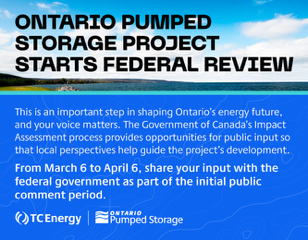
I am writing in response to Scott Dunn’s recent coverage in the Owen Sound Sun Times regarding the upcoming federal Impact Assessment for TC Energy’s proposed pumped storage project, titled “Federal impact assessment of Meaford pumped storage plan starts soon.” The article highlighted the growing public interest in the start of the IAAC process and referenced commentary from TC Energy, which appears to have been issued to local media around the same time.
TC Energy also issued a letter responding to some of the questions raised. In doing so, they appeared to acknowledge — at long last — the forthcoming release of the technical, scientific, environmental, geotechnical, and cost-related studies that residents, Indigenous communities, and municipalities have been requesting for years.

This acknowledgment is welcome, but it also signals the beginning of an enormous amount of work for everyone affected.
The release of these long-awaited studies will likely involve thousands of pages of complex material spanning engineering design, groundwater and karst assessments, drilling results, contamination data, environmental impacts, and economic modeling. For the Municipality of Meaford, neighbouring communities, Saugeen Ojibway Nation, and residents around Georgian Bay, reviewing such material will be a significant undertaking requiring time, expertise, and resources.
For many, this will be the first meaningful opportunity to examine information that has until now remained unavailable. But meaningful review can only occur if sufficient time is granted for communities and local governments to absorb, analyze, and respond to what TC Energy submits.
Second, on the claim that “BESS is not suitable”:
This statement suggests that a formal alternatives comparison has been conducted. It has not. The Ontario Government has never issued a competitive call for alternative 1,000-MW storage solutions for long-duration grid support. As a result, no BESS proposal exists for comparison. Without such a process, TC Energy’s assertion is speculative. A fair assessment requires transparent, evidence-based evaluation of alternatives — not opinion-based conclusions.
Third, on municipal responsibility:
TC Energy has implied that Save Georgian Bay is responsible for submitting community concerns to the IAAC. This is incorrect. It is the Municipality of Meaford that bears the civic responsibility to present the technical issues raised over the past six years — including groundwater risk, karst instability, contamination concerns, and public safety — supported by independent expertise. If the municipality fails to provide these analyses, critical risks may be overlooked entirely in the federal review.
No one disputes that Ontario will require additional energy capacity in the future. The question is whether the assessment of this particular project can be fair, transparent, and grounded in complete information. With key studies still withheld, a compressed review window, and no comparative alternatives analysis, that does not appear possible at this time.
As the federal Impact Assessment moves forward, the public deserves a process that is transparent, accessible, and not rushed. The release of studies should be followed by adequate time — months, not weeks — for municipalities, First Nations, environmental groups, and residents to conduct proper review and prepare submissions grounded in evidence.
Your continued coverage will be essential in helping the Meaford community understand the scope of what is coming and the work that lies ahead.
Sincerely,
Pat Zita, Meaford