Submitted by Ryan Scott
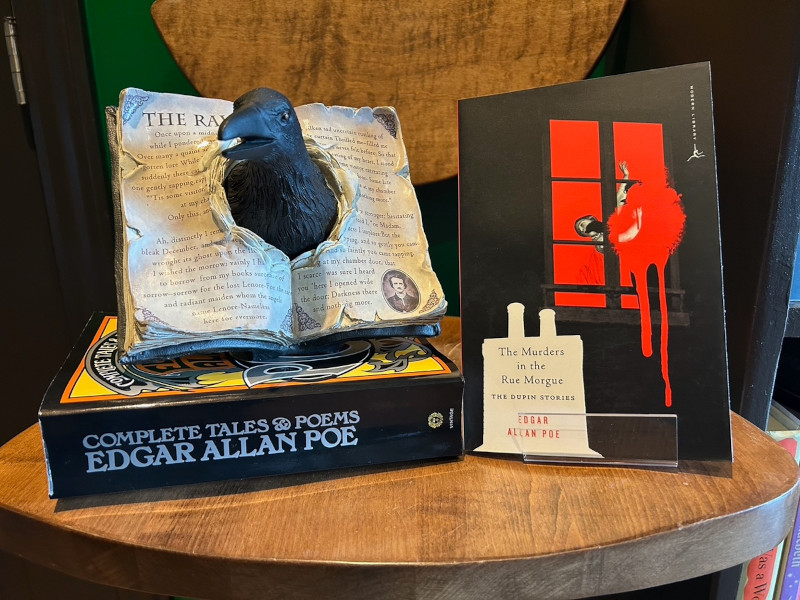
As the nights creep in earlier, the trees become skeletal, and the autumn winds howl with torment, it’s time to settle into spooky season with a book of stories to match. While tales of terror are plentiful, why not start with the grandfather of modern horror himself, Edgar Allan Poe?
Born in Boston in 1809 and losing both parents before age three, Poe stumbled through a life of addiction, poverty, illness, and death. He became one of those authors who turned endless pain into stories and poems exploring both physical and psychological horrors: works that still resonate 200 years later.


Best known for his 1845 poem ‘The Raven’, this was his greatest success in a writing career that achieved only mixed recognition. Its verses tell of a student pining for his lost love all while driven mad by a talking raven that says ‘Nevermore’ ad nauseam. While its fame never dwindled, the poem got a modern boost with its recitation by James Earl Jones in the 1990 Simpsons Halloween episode Treehouse of Horror. Jones’s bassy reading, along with other celebrity renditions, can be found on YouTube. While ‘The Raven’ may be his best-known work, the shorter and more rhythmically haunting poem ‘Annabel Lee’ remains my favourite.
Poe’s short stories are legendary and most can be read in under an hour. ‘The Fall of the House of Usher’, ‘The Pit and the Pendulum’ and ‘The Masque of the Red Death’ build tension and terror in ways that continue to inspire modern horror plots. My favourites are ‘The Tell-Tale Heart’ for its use of guilt to drive a murderer into madness, and ‘The Cask of Amontillado’ for the way it preys on the fear of being buried (or walled-up) alive.
One unexpected legacy left by Poe was his influence on detective fiction. His 1841 story ‘The Murders in the Rue Morgue’ features the Parisian private detective C. Auguste Dupin and his unnamed companion who serves as narrator. Dupin relies on precise logic to outwit police investigators and solve cases. If this sounds familiar it should. In 1887, Conan Doyle would publish ‘A Study in Scarlet’, introducing the world to Sherlock Holmes and Dr. Watson, and within that story Doyle explicitly cites Poe’s influence on his own creation. While I’d say ‘The Purloined Letter’ is the best of the three Dupin stories, ‘The Mystery of Marie Roget’ is unique in that it takes the famous 1841 murder of New York cigar girl Mary Rogers and transfers it to Paris. Poe then uses Dupin to analyze and ‘solve’ the Rogers murder through a fictional lens.
His only novel, ‘The Narrative of Arthur Gordon Pym’, written in 1838, tells of a tragic sea voyage in which desperate shipwrecked survivors have to cannibalize their cabin-boy Richard Parker. Later writers like Melville, Verne, and Lovecraft have cited the story as a favourite. Its greatest legacy, however, lies in the haunting fact that over 45 years after it was published the survivors of a real-life shipwreck also gave in to their needful pangs for human flesh. Their victim: a cabin-boy named Richard Parker.
Crushed by pain and loss, Poe kept writing despite never achieving great critical or financial success in his lifetime. He died in 1849 under circumstances as tragic and mysterious as anything he wrote about. True fame and appreciation for his work came, appropriately, after his death.
The Book Hive does its best to keep Poe on our shelves. You can find us at 84 Sykes St. N. in Meaford.