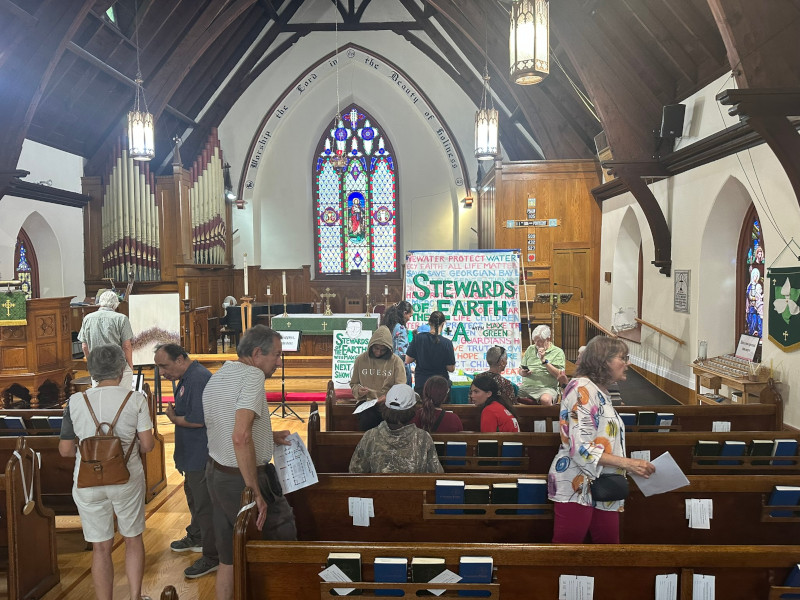
More than 200 visitors came through the doors of Christ Church Anglican on Thursday, August 13, for Art in the Pews, a one-day exhibition that transformed one of Meaford’s historic buildings into an unexpected contemporary art gallery.
Presented by GUM Gallery, the event built on last year’s Art in the Wild, inviting artists to create new work inspired by the architecture, history, stories, and symbolism of Christ Church. For four hours, the church was filled with visitors talking, exploring, asking questions, and discovering the building from a different perspective.
“We were so pleased to partner with the GUM Gallery for this show and honoured that the artists wanted to use our church’s building and stories as inspiration. The art and media were so varied but, like stained glass windows, each told a colourful, unique story,” said Rev. Brendon Bedford of Christ Church Anglican.

That connection between the living church and contemporary art was at the heart of the exhibition.
Several works responded to Christ Church’s remarkable Second World War Memorial Windows, located high in the church. The windows have an extraordinary history of their own. During the war, Rev. Harold Appleyard, who served as a military chaplain, witnessed the destruction of churches across England and later France, Belgium, and the Netherlands. He began collecting fragments of stained glass from damaged churches, bringing them back to Meaford and incorporating them into new windows.
More than 100 churches are represented in the windows, including churches in England, Ireland, and Wales, as well as France, Belgium, and the Netherlands. Some fragments are more than 700 years old, some of the oldest glass of its kind in North America.
The story of Sergeant George Stevenson, the first member of the Meaford congregation to lose his life during the Second World War, was another strong theme. Stevenson died in a training accident in Scotland in 1941 when his fighter plane crashed. Remarkably, a propeller blade survived, eventually becoming an umbrella stand in a Scottish pub before finding its way into the collection of the Earl of Hopetoun. More than 80 years later, the propeller returned to Meaford and has been donated to Christ Church.
Artists approached these stories in very different ways. Hugh Alcock reflected on the tragedy of war through First World War poetry, a shell-casing vase inherited from his grandfather, and flowers from his garden. Mikael Sandblom’s Chasing After Wind used lenticular photographs that shift between clouds and water as viewers move around them.
Caleb Sandblom created a parachute from cyanotypes made using images of the church’s stained-glass windows. The work combined ideas of protection, military history, and the building itself. Sue Adaskin responded to Stevenson’s story with a fused-glass depiction of his crash in the Scottish landscape, while Dorothy Embacher created an interactive labyrinth incorporating history, movement and sound.
Environmental concerns were also represented, with cartoonist Max Green using their work to encourage conversations about issues affecting Meaford and the wider world.
Viz Saraby’s The Stand responded to the story of Stevenson’s propeller, transforming its journey from aircraft wreckage to umbrella stand and back to Meaford into a meditation on war, survival, usefulness, and what it means to ‘stand’ for something. Another interactive installation called Protection contrasted the apparent safety of an umbrella with frightening sounds and imagery of war, asking visitors: What makes us feel safe?
Saraby also created 16 humorous signs scattered throughout the church. They encouraged visitors to look more closely at the building, its rituals, and the meanings associated with them.
For many artists, the response from visitors was as important as the exhibition itself.
Dorothy Embacher said the event demonstrated how much the community values exhibitions that are “thought provoking, fun, interactive, and inspiring”, adding that she was proud of the artists and had learned a great deal through participating.
Councillor Rob Uhrig congratulated the organizers, calling it “an amazing event” with “lots of interesting displays, artwork, and conversation.”
That interaction between art, place, and people is precisely what the project was intended to achieve. Visitors who knew the church discovered new details in its architecture and history. Familiar stories took on new meaning through the artists’ interpretations. Those who came primarily to see the art often found themselves learning about an interesting piece of Meaford’s past.
Art in the Pews was also a reminder that art exhibitions do not have to be in traditional gallery spaces. For one afternoon, the pews, arches, windows, and walls of Christ Church became part of the event itself.
The event demonstrated the appetite in Meaford for creative experiences that connect art with local history and community life. It also showed that a historic building need not remain fixed in the past. Sometimes, all it takes is a group of artists and an invitation to look again.
To see more photos, pick up the August 20 print edition of the Meaford Independent.