To the Editor,
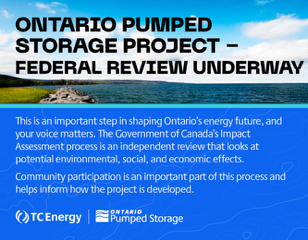
In a recent letter, Bruce Mason suggested that opposition to the Pumped Storage Project is largely futile because the final decision rests with higher levels of government, not Meaford Council.
That raises an obvious question: If council has no power, why has TC Energy spent years seeking its support?


Why pursue resolutions of support? Why meet with councillors? Why engage local organizations? Why invest heavily in public relations and community outreach? Why continue seeking endorsements from influential local voices?
The answer is simple. Municipal support matters.
No one disputes that the Province of Ontario ultimately holds the approval authority. But major infrastructure projects are not approved in a political vacuum. Provincial decision-makers pay attention to municipal resolutions, public opinion, Indigenous concerns, media coverage, expert reports, and the presence or absence of community support.
A municipality cannot always stop a project. But it can influence whether that project is viewed as having social licence.
Reporting published by The Narwhal described comments made by former political staffer and TC Energy executive Liam Iliffe during an internal company “lunch and learn” session on the “base tactics” used to persuade politicians and members of the public to support major projects. According to the reporting, these tactics included cultivating relationships with decision-makers, shaping public narratives, leveraging influential validators, and building support at multiple levels of government. Iliffe noted that the Ontario Pumped Storage Project employed “not dissimilar base tactics.”
The same reporting quoted TC Energy Vice-President Matthew Forestell explaining why local support matters: “communities lead and politicians follow,” and that building support from the ground up creates the space for politicians and regulators to provide support. If council support has no influence, why would TC Energy devote so much effort to securing it?
Whether one accepts all of the claims contained in those reports is ultimately beside the point. The larger lesson is clear: corporations devote considerable time and resources to building political and community support because such support has value.
If local support were meaningless, there would be no reason to seek it.
Bruce Mason’s argument unintentionally highlights that reality. The fact that TC Energy has invested years engaging municipalities, community organizations, Indigenous communities, and local residents demonstrates that local voices matter. Companies do not spend years pursuing support that carries no weight.
Meaford Council may not cast the final vote on the Pumped Storage Project, but its voice still carries influence. Its resolutions become part of the public record. Its concerns can influence regulators. Its advocacy can attract the attention of provincial decision-makers. Its support, or opposition, helps shape the broader narrative surrounding the project.
The greatest myth surrounding this proposal is not that council has too much power. It is that council has none.
If local support were truly irrelevant, TC Energy would have stopped seeking it years ago.
Sincerely,
Pat Zita, Meaford