Dear Editor,
I am writing with deepening concern regarding the intersection of two developments that, taken together, pose a serious long-term threat to Ontario’s water security, the Great Lakes environmental protection, and public oversight.
The most recent is the Ontario government’s passage of Bill 60, which enables provincially designated corporations to operate water and wastewater services. Although the government describes this as administrative modernization, the structure of Bill 60 gives the Minister wide authority to assign control of local water systems to corporatized entities that may be permitted to issue shares, carry debt, and operate with financial-return obligations typically associated with for-profit models.

This shift away from direct municipal control raises immediate risks: weakened transparency, reduced public accountability, diminished local authority over source-water protection, and incentives to recover costs through higher rates or revenue-generating activities. It also creates a legislative foundation from which water could, intentionally or unintentionally, become increasingly commodified.
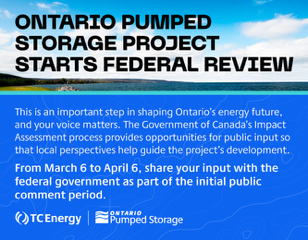
My concerns are amplified by the Ontario government’s continued support for TC Energy’s proposed open-loop pumped storage system in Meaford, including $285 million in provincial pre-development funding. The Provincial Minister of Energy has repeatedly expressed support for the project despite unresolved environmental questions, strong local opposition, and the fact that open-loop systems continuously withdraw and discharge water from a public waterbody—in this case, Georgian Bay.
When Bill 60’s corporatized water-service framework is combined with provincial investment in a large-scale, water-dependent energy project led by a private corporation, it raises a troubling possibility: the groundwork may be forming for the long-term commodification of fresh water, including potential export pressures. While no government has stated such an intention, the legislative and financial alignment is concerning, especially as U.S. states increasingly face freshwater scarcity.
Ontario’s freshwater resources must never be treated as a market commodity. Once the mechanisms for corporate control and revenue extraction are established, it becomes far harder to restore full public oversight or prevent future governments—or corporations—from pursuing bulk transfers or cross-border sales under economic or political pressure.
I urge everyone to step forward and make your voices heard. We cannot allow a handful of wealthy corporate executives, a Premier with a demonstrated history of stacking the deck on environmental matters, and select members of Council to make decisions of this magnitude without meaningful public oversight. The future of Georgian Bay and the Great Lakes is far too important to leave in the hands of a few—our collective action is essential to protecting what truly belongs to all of us.
Sincerely,
Therese Defoy, Meaford