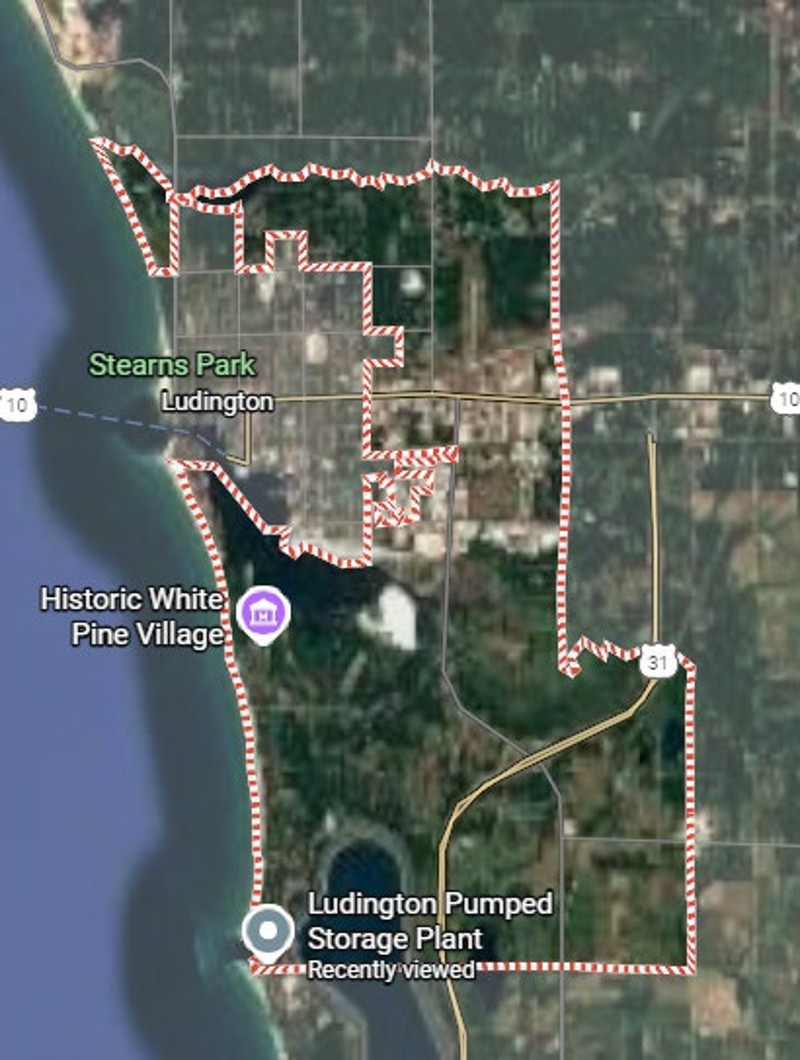
In late November of last year, three Meaford councillors, along with the CAO and two members of municipal staff, visited the Ludington Pumped Storage Facility in Pere Marquette Township, Michigan. During their visit, Deputy Mayor Shirley Keaveney, Councillor Rob Uhrig, and Councillor Tony Bell were able to tour the facility as well as meet with the local council, Chamber of Commerce, and residents of the area in order to understand the impact of a pumped storage facility more than 50 years after it was constructed, and how that facility compares to the pumped storage facility proposed by TC Energy to be built on the 4th Canadian Division Training Centre lands.
“The visit was facilitated by TC Energy and included a representative from Grey County’s Economic Development department. During the visit to Michigan, the Municipality received a tour of the site from Consumers Energy, met with local Council members and staff, and spoke with the local Chamber of Commerce, hearing directly from business owners in the area about their experience as a host community,” staff advised in a nine-page report presented to the Pumped Storage Advisory Committee (PSAC) on January 29. “This visit was intended to support Council’s understanding of the proposal and does not represent a decision for or against the project in Meaford.”
While members of the Pumped Storage Advisory Committee were not included in the visit to the Ludington facility, a list of questions provided by members of the committee was used to help guide discussions during the visit.


“The visit to Ludington provided Council and staff with an opportunity to observe an operating pumped storage facility and to hear directly from a host community about its experience over several decades. In advance of the tour, staff reviewed questions provided by members of the Pumped Storage Advisory Committee and used those questions to help guide discussions during the visit,” staff advised in their report.
The report provided the committee with a largely positive view of the Ludington facility, and of the community’s experience over the past half century.
“The facility operates under comprehensive state and federal regulatory oversight and is subject to relicensing every 50 years. Originally constructed in the 1970s, the Ludington facility was relicensed for the first time in 2019 and is permitted to operate until 2069. Regulatory requirements address operational safety, infrastructure integrity, environmental protection, and coordination with surrounding jurisdictions. Municipal roads were identified as an important consideration within this regulatory and operational framework,” staff noted in their report. “Discussions with local Council and municipal staff focused on the long-term fiscal implications of hosting a pumped storage facility. Local Council shared that the Ludington facility represents approximately 70 per cent of the municipal tax base, making a significant contribution to the township’s annual operating budget and supporting the delivery of local services. It was noted that the Ludington facility is located on privately owned lands and contributes to the township’s revenues through property taxation, with assessments based on construction and building value rather than land value. This approach is consistent with how other specialized infrastructure assets are assessed and reflects the facility’s role as long-term, regulated energy infrastructure.”
During the visit, it was learned during discussions with the local Chamber of Commerce that the Ludington facility employs roughly 50 full time equivalent positions today, though during construction, the community saw a large influx of workers, some of whom remained after the project was complete.
“Operational staffing at the pumped storage facility was described as approximately 50 full time equivalent positions, encompassing maintenance, operations, leadership, technical, safety, and support roles, along with additional contractors as needed. During construction periods, employment reached approximately 2,800 full time equivalent positions. The proposed project’s operations requires the availability of qualified personal, which creates an opportunity to align with the Georgian College Sydenham Campus in Owen Sound,” staff noted in their report. “Chamber members noted that construction resulted in a significant temporary population increase, with many workers choosing to remain in the area following project completion due to employment opportunities and the quality of life in a waterfront community. Many established their own businesses in town once construction was completed.”
CAO Shawn Everitt told the committee that among his primary concerns is how the municipality would cope with such a large influx of workers during the construction phase.
“There could be eight years where this municipality, and this region could see 1,800 workers to build this plant,” Everitt told the committee. “My concern is that after year eight, it takes roughly 35 people to operate this plant. So, we need to get our heads in a direction of figuring out how can our community handle the potential influx of people over the course of that construction, and then be sure that we haven’t over built to then see this lowering of the population.”
The report also noted that the Ludington facility has become a “normalized part of the community over time, noting that it is widely understood and accepted as part of the local landscape,” that attracts as many as 500 visitors each year to designated outlook areas.
“Feedback from the community on the facility has been overwhelmingly positive, with no significant concerns raised. Residents choosing to live nearby the facility are now well established and coexist alongside the facility,” the report informed. “In addition to tourism and public access, participants highlighted the importance of community benefit programs associated with the facility. Of particular note is a $1 million annual Fish Trust, established through a partnership between the facility operator and the municipality. Funds are administered through an advisory group, which is responsible for recommending how funds are allocated to support local priorities and environmental initiatives. This includes improvements to parks and waterfront spaces, as well as programs to replenish fish populations.”
Since the proposed facility first became public knowledge in 2019, local advocacy group Save Georgian Bay has been raising awareness locally and expressing opposition to the proposal. The group has held a number of protest rallies and has collected thousands of signatures on petitions opposing the proposed facility.
The concerns of Save Georgian Bay and other opponents are many, ranging from fears that the facility would have negative impacts on the environment, including negatively impacting fish in the bay, to concerns that homeowners in close proximity to the site could be in danger of flooding should the reservoir fail. Many have also expressed concern about the cost of the multi-billion dollar proposal, and whether pumped storage should be favoured over battery storage. Save Georgian Bay has said that their work over the past six years has highlighted roughly 30 federally protected species at risk on the project’s proposed site. The group has also expressed concern about the potential contamination of the DND land that could find its way into residential drinking water during the construction of the facility.
TC Energy, on the other hand, has said the proposal is a green initiative that would consume inexpensive off-peak power at night to pump water from Georgian Bay into a 374-acre storage reservoir located 150 metres above the Georgian Bay shoreline on the military base. The reservoir, which would hold 20 million cubic metres of water, would be emptied back into Georgian Bay during peak usage periods, driving hydraulic turbines to generate electricity.
While there were issues with impacts on local fish populations initially, the report notes that today, Ludington is the ‘number one salmon port on Lake Michigan’.
“While the facility incorporates several layers of netting and protective measures to prevent fish from entering the pumped storage system, the Trust provides a mechanism to address any residual impacts by supporting fisheries health within the broader ecosystem. Chamber members described this program as an example of how long-term infrastructure can be paired with locally guided investment to deliver community benefits over time.”
During the committee discussion, the CAO also noted that the Ludington facility conducts ongoing monitoring of more than 100 active groundwater wells.
“The reservoir is constructed with a lined clay bottom and concrete and asphalt sidewalls, which are relined on a long-term cycle of approximately 50 years. Ongoing monitoring includes more than 100 active groundwater wells, with conditions reviewed through monthly reporting. The system is designed to accommodate a controlled leak rate of approximately 9.5 litres per second,” staff noted in their report.
The full report is available on the municipal website (meaford.ca)
Correction February 16, 2026: This article originally identified Councillor Harley Greenfield as having been one of the three councillors that attended the Ludington visit, however the members of council who attended were: Deputy Mayor Shirley Keaveney, Councillor Tony Bell, and Councillor Rob Uhrig.